|
“You’re getting pretty close, though.”
“But because you can already ski like that, you’re not progressing beyond it, my friend.”
…And with comments like these constantly being thrown at him by yours truly, M-san joined me for a short lesson session.
The theme this time was increasing the range of motion needed to return to the B-tele icon position.
In other words: keep the upper body upright, don’t collapse inward, and become small underneath.
Fold only the legs.
Apply some CHU♪.
Bring the Achilles tendon and the hips together.
Point the knees sharply forward.
…There are many different ways to say it. Whatever wording clicks is perfectly fine.
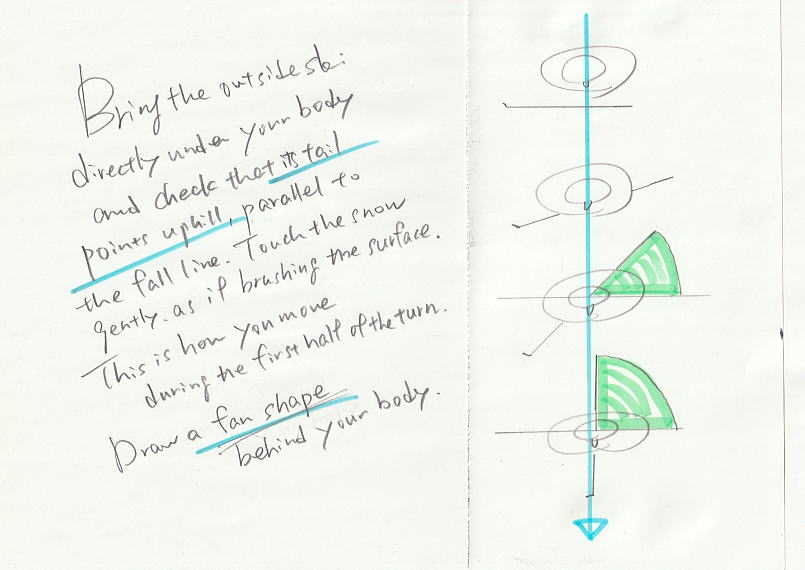
The important thing is simply to create a fan-shaped movement behind the body.
And if “fan-shaped” doesn’t work, imagine a quarter slice of pizza instead.
(Though apparently in Italy they would never cut pizza this way…)
This, at least in my own interpretation, is the key point of what Japanese skiers call “tanimawari.”
In English, perhaps this would be called the “first half of the turn”?
The more difficult the snow conditions become, the more carefully I use this fan-shaped movement.
The shape is drawn using the outside edge of what had been the downhill ski.
As you can probably imagine, this simply cannot be done unless the crossover happens smoothly.
And furthermore, this is really a movement unique to heel-free skiing ー
or low-cut boots ー where the feet can spin directly beneath the upper
body.
In other words, the movement of returning toward the B-tele icon position
is this fan-shaped “tanimawari” ー the first half of the turn.
Then, from there, another fan shape is drawn again, becoming the “yamamawari”
ー the second half of the turn.
As for M-san, he copied it immediately and was happily skiing around afterward.
By the next time I see him, he’ll probably be a completely different skier.
|