|
Unlike a mogul line served by lifts, where traffic is basically one-way, the mogul lines on the Norikura Snowfield in July are a little different.
Of course, there are skiers coming down.
But right alongside the line, there is also a steady stream of people carrying their skis back up.
And on weekends, if you have to wait your turn to ski down, you also have to queue up to walk back up.
So, basically, you’re in an environment where a lot of people are watching you ski.
If you’re a reasonably good skier, no problem.
But if you’re at the stage where you really have no chance against the moguls yet, this can be pretty tough.
“I’m getting in everyone’s way.”
“I don’t want to hold people up.”
Well, that’s a perfectly natural feeling.
So then... what do you do??
Is there a way, on the Norikura Snowfield in July, to practice skiing moguls on telemark skis at your own pace, without worrying about everyone around you?
“Yes, there is!”
And that’s what this video is about.
(Niche content? Bring it on!!)
The idea is simple.
We use the tracks that alpine skiers have naturally dug out by skiing over the same spot again and again.
They’re not really moguls.
More like deep, carved-out ski tracks.
The slope is much gentler than the actual mogul line. And if you can find a similar setting on a ski area’s gentle slope, even better.
Because the slope is gentle, the tracks tend to become long and stretched out.
Gentle slope / long, vertical tracks.
This combination works surprisingly well as a foundation for learning to
ski moguls on telemark skisーor heel-free skis in general.
And of course, the technique I’m using here is B-tele.
So, here are a few things I’d like you to watch for in this video.
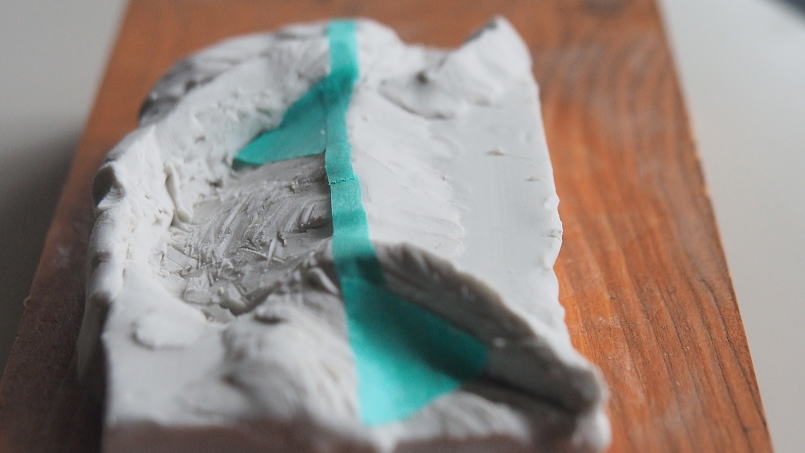
The tape running straight down the middle is the fall lineーand the center
line.
Basically, the idea is to travel down that line from top to bottom.
In other words, straight running.
Which is exactly why the slope has to be gentle.
Put another way:
“You can do this because the slope is gentle.”
Now then.
The braking happens lateーonly in the final part where it’s actually needed.
The skis are turned sideways, and speed is scrubbed off with a smear.
In B-tele, this smearing action is created by extending the body.
And because you’re dealing with the face of a bumpー
“TAP!!”
ーyou get hit with the impact.
Then, instead of suddenly releasing all the pressure, you shorten the body and ease your way over it.
Almost licking your way over the bump.
That’s the B-tele icon position.
The skis then start to change direction through the unwinding of the twist.
And now comes the important part~
The moment the skis are pointing straight down the fall line, stop the rotation.
Then just continue straight down along the green line.
The important thing is not to keep spinning the skis around like a propeller.
Don’t keep turning.
Create a moment where you can simply fall straight down.
Consciously create that moment.
Learn to make it happen.
That’s the process here..
And the brake, by the way, has nothing to do with making a turn.
You slow down by smearing the skis into the face of the bump.
Straight running / braking / straight running / braking...
That’s the pattern.
And honestly, I think this is what a mogul line really is.
You slow down by extending your body and shaving snow.
You accelerate by staying in the icon position and running straight.
Of course, this is only an image, but the body is always on the center
lineーor the fall line.
And I think this might be the dividing point between being able to ski a mogul line or not.
Straight running / braking.
If you start thinking, “Okay, I need to turn now!”...
Well, especially in telemark skiing, where the feet are moving into a fore-and-aft position, the road can become a pretty tough one.
I understand the feeling.
On a mogul line, you want to think:
“I need to get the skis around quickly!”
“I need to brake quickly!”
But in my experience, I’ve never seen anyone arrive at a smooth solution starting from that idea.
The skis don’t need to spin around like a propeller.
First, get over the bump.
Fall.
And then apply the amount of braking you need, as quickly and directly as possible.
A gentle slope is where you can safely work this into your system.
Sorry, that turned into another long one.
Hope the video is useful..
|