|
After sending the guests off to their respective ski areas, things finally settled down.
So… what should I do now?
I glance out the window. Hakunori’s slopes.
“…No one’s there…”
Hakunori it is, then.
When choosing a ski hill, the number one condition is simple: no people.
Leather boots on at the entrance, a pair of two-meter skis on my shoulder, padding along.
Lift No. 4.
Ahhh… this slowness. This wonderfully slow pace.
There can’t be more than ten people skiing.
If the goal were really to increase visitors, there are ways to do it…
but never mind.
First run: B-tele.
Man, that feels good.
“…Hakunori might be more than enough,” I think to myself.
Second run.
This time I keep the same pace, without changing leads.
In telemark skiing there’s the term “lead change.”
In alpine skiing, a change usually means a side-to-side edge change.
That part is often called the crossing-over phase.
Once that’s done, you either smear the skis or let them bite.
But really-what is this whole “lead change,” this front-and-back thing?
Thinking about that, the third run is for checking a self-shot demo of
“tips for jump turns / jump transitions.”
Here, by jump turn, I mean focusing only on the edge change.
It’s not about the 180-degree rotation in the air you see in check-hop turns.
You give a small, gentle pop, and the edges switch.
After that, you just stand on the skis and they head off that way.
Another small pop-and now they go the other way.
A technique that lets you finish a tricky edge change instantly, without overthinking it, isn’t bad at all.
Naturally, it’s very effective off-piste.
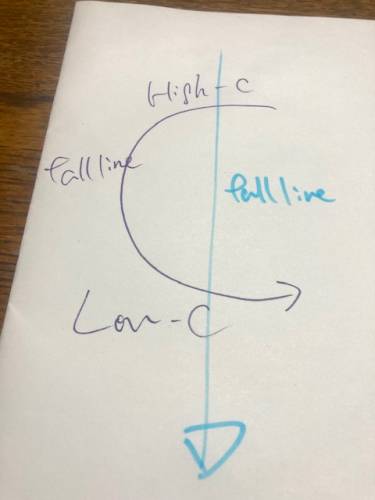
…High-C, huh..
So the fourth run is done using a method that deliberately creates a high-C.
This is something I was doing myself in the 1990s,
in a VHS video we shot in New Zealand and later sold in Japan,
[Power Telemark].
At the time, it was probably a fairly innovative idea.
But in the end, it’s a method that assumes dropping into a telemark position
once during low-C.
It allows you to express untill the fall line as slowly as you like,
but fast movements are, frankly, quite difficult.
Partway down the slope, I start thinking,
“This is kind of silly,”
and switch back to B-tele.
That’s the story behind the fourth video.
It brings back memories of the days when I lived on Turn Planet.
Well… I suppose I’ve got my own history, too.
In the afternoon, the guests return and things naturally turn into a party.
On warm, sunny days, it’s BBQ outside.
No question about it.
|