|
I had a few personal thoughts on my mind, so I rode the lift just three times right before closing.
What prompted this was that I spoke a little with a guest about where I look, and what I instantly analyze, when watching someone ski.
The first thing I look at is the arms.
Are the elbows spread out to the sides?
Do the elbows move jerkily, or not?
Do the arms twist inward in the latter half of the turn?
Are the elbows kept close to the body, or positioned forward?
From this alone, I can roughly tell someone’s style.
The arms tend to synchronize easily with the movement of the legs, after all.
Then there is the overall picture.
Is the upper body falling forward, or is it closer to upright?
And the reason why that posture appears-
once you can see that, even a slow lift ride doesn’t feel boring anymore.
Oh, and there are also people whose pole baskets jump up to around shoulder height with every single turn.
That’s something you probably won’t notice unless someone films your skiing,
or you record yourself.
There is always a proper chain of movement and a reason behind that as well.
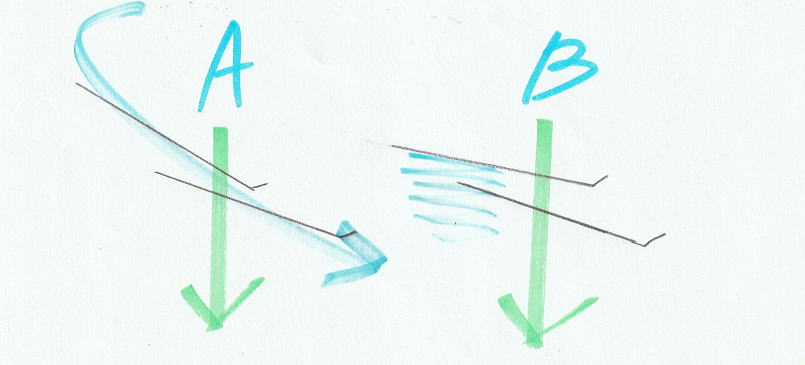
Now then, today’s point of focus was to observe the angle created by the two skis.
The setup was plastic boots (T4) with 75 mm bindings.
The location was a groomed ski slope.
In what you might call a standard or typical telemark style
(what we call A-tele),
many people probably end up with an angle like the one shown in the diagram above.
This is another thing you won’t really recognize unless you film it yourself.
With B-tele, on the other hand, the angle would look more like this.
If you watch the YouTube video above at around 0.25× speed, it becomes very clear.
This is how it looks with T4s.
With low-cut leather boots, it’s possible to create an even sharper angle
(see the second video).
Well, so what?-that’s not the point.
This time, I preemptively recorded some easy-to-understand self-shot videos
in order to explain the fifth and sixth items
out of the six effects produced by “CHU♪”
to future guests.
Ahh, slope-side really is convenient.
Self-filming LOVE♪
January 3, 2026
|