|
Are Turns Emotional?
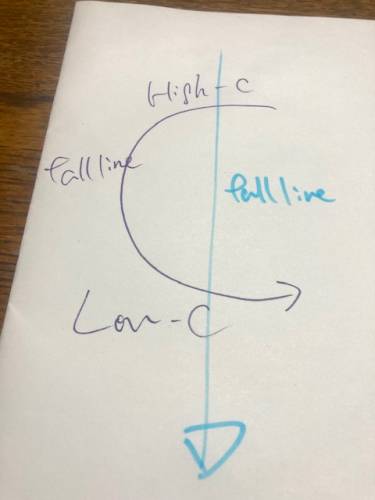
When we think of a turn, many people probably picture the shape of the letter “C.” Instructors, in particular, might be the most typical example. We call the upper half of the turn High-C and the lower half Low-C.
High-C is the part that signals, “Here comes the next turn!” It’s a moment filled with anticipation, excitement, anxiety, and that little “Will I make it?” feeling?a truly emotional phase. If anyone finds skiing enjoyable because of the turn itself, I suspect it’s this High-C that forms the core of that pleasure. This seems to hold true for both alpine and Telemark skiing.
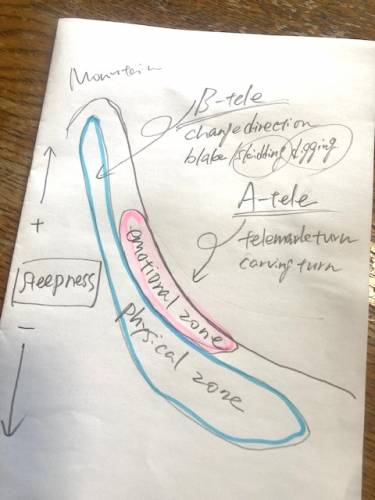
In a turn, it’s the transition from finishing a Low-C to entering the next High-C that really showcases the skill. But my B-tele is a little different. Thanks to the heel-free design, I can bring my knees forward and place both feet directly under my torso. The result is a perfectly straight rotation axis, allowing for a smooth spin.
This makes it possible to skip the High-C and fall line phases entirely and enter Low-C almost instantly. Structurally, it’s spin → Low-C. Since Low-C is the braking phase, it effectively becomes “change of direction → braking action.”
Returning to the main point, High-C is emotional, and Low-C mainly involves physical elements. Skiers who think of skiing as “turning” naturally focus on High-C, while those who see skiing as “braking” pay attention to Low-C. Turns are emotional, brakes are physical.
From this perspective, one might even characterize the two styles with words: A-tele is emotional, B-tele is physical. I came to this thought while skiing at Tateyama the other day, observing those around me?it just occurred to me in that moment.
|